The Euler spiral, also known as a clothoid or Cornu spiral, is a mathematical curve whose curvature changes linearly with arc length. It was first studied by Leonhard Euler and later by Marie Alfred Cornu in the context of optics.
Mathematical Definition
The Euler spiral is defined parametrically by the Fresnel integrals:
The key property is that the curvature κ(s) = s, where s is the arc length parameter.
Properties
Linear curvature: The curvature increases linearly with arc length
Spiral behavior: The curve spirals inward with decreasing radius
Symmetry: The curve has rotational symmetry about its center
Asymptotic convergence: Both branches converge to specific points as t → ∞
Applications
Euler spirals have practical applications in:
Road design: Smooth transitions between straight sections and circular curves
Railroad engineering: Gentle acceleration changes for passenger comfort
Optics: Fresnel diffraction patterns and wave propagation
Computer graphics: Smooth curve interpolation and path planning
MATLAB Simulation
This simulation demonstrates the spiral’s formation through incremental construction:
close all

theta = 1.01; % Angular increment (make small changes for smoother curves)

point1 = [0 0];  % Starting point
length = 360*2;  % Number of iterations
rad0 = 0;        % Initial angle

x = zeros(length,1);
y = zeros(length,1);

for i = 2:length
    % Increment angle based on position (creates linear curvature change)
    rad1 = rad0 + (i*theta)*pi/180;

    % Calculate next point
    point2 = point1 + [cos(rad1) sin(rad1)];

    % Store coordinates
    x(i) = point2(1);
    y(i) = point2(2);

    % Update for next iteration
    point1 = point2;
    rad0 = rad1;

    % Plot the evolving spiral
    plot(x, y, 'k-')
    axis equal
    axis off
    % Uncomment for animation:
    % drawnow
    % pause(0.1)
endVisualization
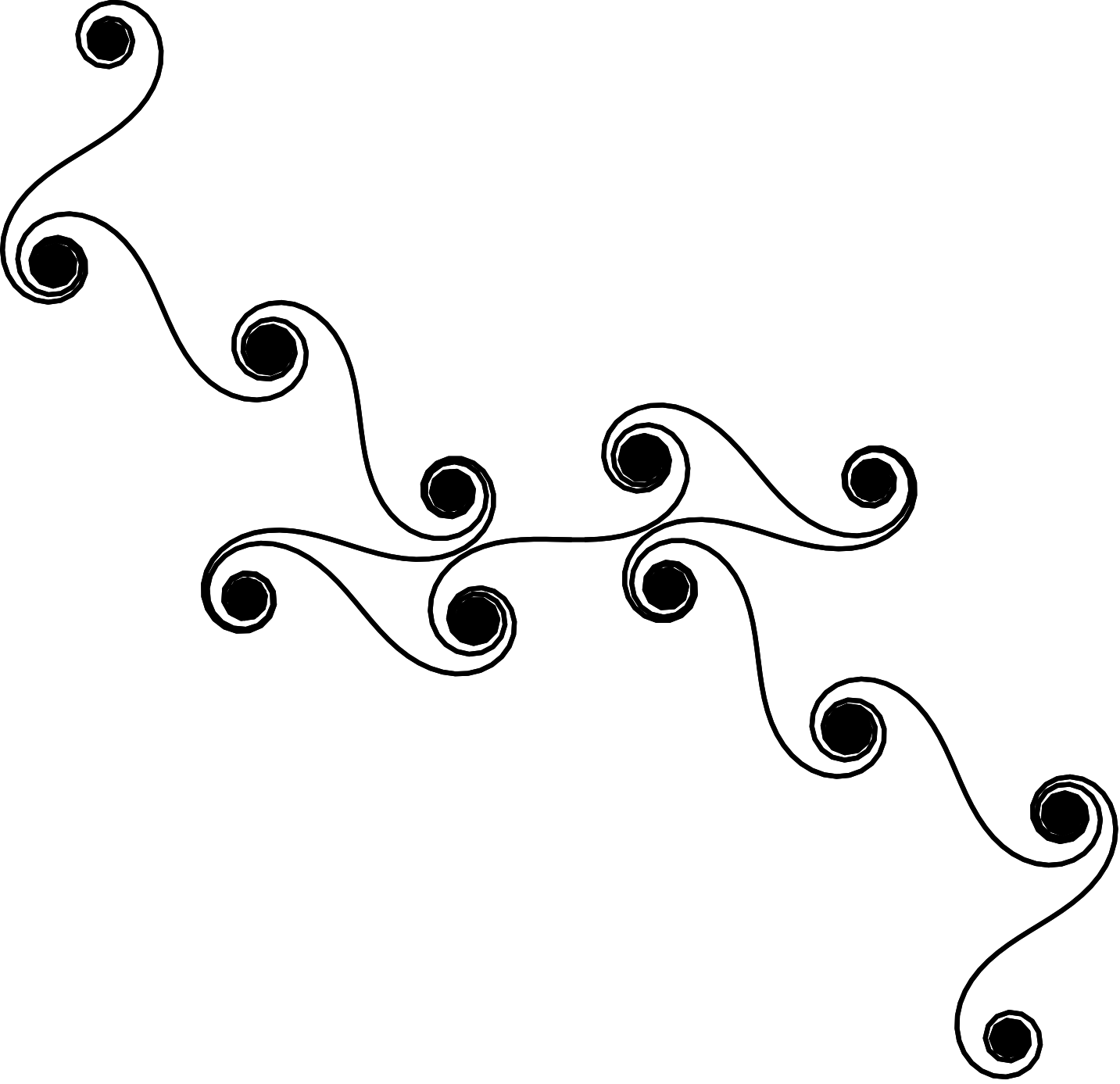
Figure 1:The Euler spiral showing the characteristic inward spiraling pattern with linearly increasing curvature. The curve starts straight and gradually curves more tightly as it progresses.
Variations
The parameter θ in the simulation controls the tightness of the spiral:
Smaller values create tighter spirals with more rotations
Larger values create looser spirals with fewer rotations
The relationship between θ and final spiral characteristics is nonlinear